
Humanness Heroes, I want to speak to you about something I have been sitting with quietly.
You have likely seen the posts, calls to conscience, public declarations about where not to spend, which businesses to avoid, and where moral lines should be drawn. The intent is often sincere. Many people want their spending to reflect their values and to act with integrity inside systems that feel distant and unresponsive. In a world where power often feels remote, consumption can feel like one of the few remaining levers of agency.
What I am wrestling with is not conscience itself. It is the system that conscience activates, and the human beings who quietly carry its cost.
Moral clarity versus moral agency
Picture a storefront that becomes controversial overnight. The decision that sparked the backlash was made far above the store level, perhaps years earlier, perhaps by leaders no longer present. The manager finds out the same way everyone else does, through their phone. Within days, foot traffic slows, hours are cut, and staff reductions quietly follow.
No one asked what those employees believed.
No one asked whether they agreed.
No one asked if they could absorb the fallout.
The moral stance feels decisive and visible; the consequence is neither. When a business is publicly condemned through association, real or perceived, we often assume alignment and consent across the system. In reality, most people inside modern work systems do not have moral agency at the level being judged; they have jobs, schedules, families, and commitments they did not negotiate.
When we name and condemn a business in the name of conscience, who actually absorbs the consequences, and do they have any say in the moral stance taken on their behalf?
Visibility versus impact
Public moral declarations feel powerful because they are seen. They gather agreement quickly and reassure us that we are on the right side of something. However, the impact rarely announces itself the same way.
A small supplier sees an order paused indefinitely, or a contractor’s renewal quietly disappears. A single parent rearranges childcare after yet another unexpected shift change. None of this shows up in the original post. None of them trends.
The moral action is loud, but the human impact is quiet.
What we see is affirmation, but what we do not see is adjustment, strain, and loss happening privately, carried by people whose names were never spoken and whose values were never consulted.
If moral clarity is expressed publicly and at scale, how do we account for the human cost that travels quietly through payrolls, supply chains, and families we never see?
Where power sits versus where risk lands
Most modern economic systems centralize power and distribute risk downward. Executives, administrations, and institutions are buffered by distance; frontline workers, vendors, and families are not.
When demand shifts suddenly due to public pressure or consumer activism, the system does not first recalibrate upward; it tightens below: hours are reduced, contracts end, and precarious roles disappear fastest. Those with the least savings, the least flexibility, and the least mobility bear the impact first.
This is not about intent or malice; it is about structure.
From a systems perspective, conscience-driven consumption rarely disrupts power; it often reinforces existing patterns of risk transfer, even when it feels morally satisfying.
In systems where power is centralized but risk is distributed downward, what responsibility do we carry for the people who bear the impact of our moral declarations?
Speed versus understanding
Social platforms reward immediacy: conviction moves quickly, and lists and declarations travel faster than nuance or systems understanding. Once a moral position is posted, the work feels complete.
But consequence unfolds slowly. It shows up weeks later in depleted savings, missed rent, postponed plans, and quiet decisions made under pressure. By the time those consequences surface, attention has already moved on. The post is forgotten; the cost remains.
Moral certainty feels clean and decisive. Reality is neither.
What happens to humanness when moral certainty moves faster than our understanding of who will pay for it?
I am not resolving this tension; I am staying with it.
Why? Because systems do not feel our convictions, people do. And humanness in the hustle requires more than ethical intent; it requires systems awareness, restraint, and a willingness to consider not only what we stand for, but who stands underneath the structures our certainty activates.
If this reflection stirred something for you, sit with it. Notice where your own moral certainty feels most settled, and where it might benefit from a wider view of who carries the cost.
 Humanness in Being Let Go
 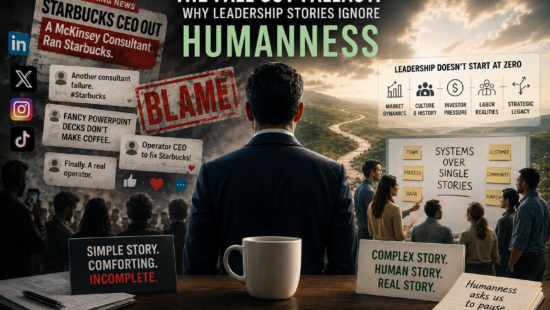 The Fall Guy Fallacy: Why Leadership Stories Ignore Humanness
 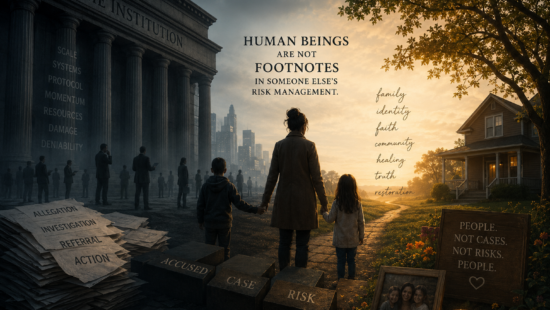 Humanness and the Architecture of Scale
  Humanness and the False Binary: Stewardship as the Missing Thread