
Welcome back, Humanness Heroes.
There is a particular kind of story I keep encountering, one that does not announce itself as a story about humanness, but reveals itself to be one if you stay with it long enough. It is a story about an institution, a family, and what happens when the first decides to act against the second.
Let me tell it to you.
Maya
Maya had built something: a platform, a community, a business that bore her name. She had been written about, spoken at conferences, mentored women trying to do similar things, and her work was the kind that made strangers reach out to her about something she had said.
Her husband worked at a large company, the kind that owns the infrastructure underneath much of what you use during a normal day. He was deeply embedded in his industry, well-regarded, the colleague that other colleagues asked when they did not know who else to ask.
Some years ago, a former employee of a contractor that did business with her husband’s company sent an unsolicited email to the company’s founder. The email made a serious accusation, the kind that, if true, would have implicated her husband. The accuser, it would later emerge in deposition, admitted he had no real evidence; it was, in his words, an assumption and hearsay. What he did have was a request: money in exchange for the information, and a job at the company.
The institution acted.
Federal agents arrived at Maya’s home in the early morning. They left with paperwork, equipment, and the frozen accounts of a family that had not yet been charged with anything. Within hours, a major investor pulled out of one of her husband’s deals, and within weeks, Maya’s own business began to feel the gravitational pull of the larger story. Outside circumstances she could not control demanded her attention at exactly the wrong time, and the locations she had built could not be kept open through the closures that followed.
Years passed. She moved her family across the country, sold what they had, and watched the version of herself who arrived in this story become someone she did not fully recognize.
Eventually, the federal prosecutors dropped the criminal investigation against her husband, the court vacated previously secured guilty pleas as not being in the best interests of justice, and seven of the institution’s eight civil claims were dismissed.
The institution is appealing.
When Maya was finally given the space to speak about what those years had cost her, she said something that I have not been able to put down. She said she did not remember who she was off the battlefield.
That sentence is the entire reason this post exists.
The Architecture Underneath
I want to say something about the mechanics, because Maya’s story is not really about one accuser, one company, or one family. No, it is about architecture.
When an institution is large enough, it does not interact with individuals as peers, because it cannot. The architecture is built to scale interaction beyond the human range, to act with momentum no individual could generate, and to deploy resources no single decision-maker could deploy, and that is part of what makes it powerful, just as it is part of what makes it dangerous to be wrong about.
Watch what happened in Maya’s case. The information came to the founder, who sent it to the team, who investigated and referred it to outside counsel, who referred it to authorities, who acted on what the institution provided. Each step was reasonable in isolation, each step left the next person with a smaller piece of the whole, so that by the time the consequences had unfolded around Maya’s family, no individual along the chain had ever held them all. This is the architecture of deniability, and it is not a conspiracy; it is what scale does.
When the institution turned out to be wrong, that wrongness had nowhere inside the institution to land. So it landed on Maya.
There is a math to this. Large institutions have dependents: employees, investors, contractors, customers, boards. When something threatens the institution, the cost of moving too slowly is calculated against the cost of moving too quickly, and the math almost always favors speed. Being wrong about a single individual is a contained cost; being slow to defend the institution against a perceived threat is a distributed cost across thousands of people, and the first can be absorbed while the second cannot.
So the institution moves, with all of its weight behind it. The person on the receiving end has themselves, their family, their savings, their lawyer, and whatever credibility they had before the institution decided to act.
The math is not close.
What Remains
The institution will eventually move on. The case will resolve, the senior leaders who initiated the action will receive briefings about the outcome and move to the next item on the agenda, and the institution will return to its rhythm.
Maya will not. Even fully vindicated, even with every claim dismissed, the years are not coming back, the relationships that ended when the story became unspeakable are not returning, and the version of Maya who arrived in this story is gone.
What Humanness Asks
This is not a policy piece, and Humanness in the Hustle (HITH) does not write policy. The legal questions are real, and people more equipped than I am are working on them.
HITH asks something different. It asks whether, in the period during which an institution is processing someone, we keep seeing them as a person, whether we hold them in our attention as a parent, a friend, a colleague, a human being, while the institution holds them as a case.
This is harder than it sounds, because the institutional framing is loud, while the family’s framing is quiet, and the headlines move fast. By the time the story falls apart, the audience has moved on, the institution has insulated itself from the consequences of being wrong, and the family is still inside them.
What humanness asks is not that we resolve which side is right; it asks that we keep the family human in our attention even after the institution has stopped framing them.
A Closing Thought
Big institutions are not dehumanizing because they are evil; they erode humanness because of how they are structured, often without any individual inside them intending it. The dependents must be served, the decisions must be made at scale, the information must move quickly, and the architecture must hold. That architecture, by its own logic, cannot hold the family at the center of it. Inside the institution, they are a case.
Inside us, they can still be a family.
Humanness Heroes, that is the work: holding the person before the position, holding the family inside the case, holding the human while the institution holds the file. Even if no one else does, hold them there.
 Humanness in Being Let Go
 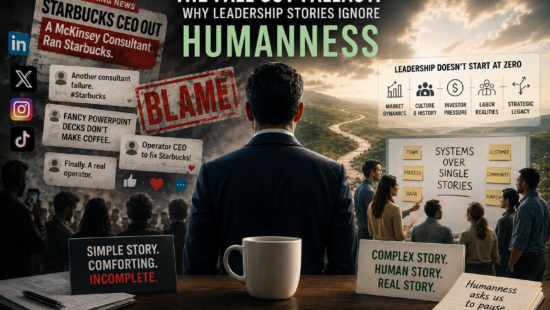 The Fall Guy Fallacy: Why Leadership Stories Ignore Humanness
 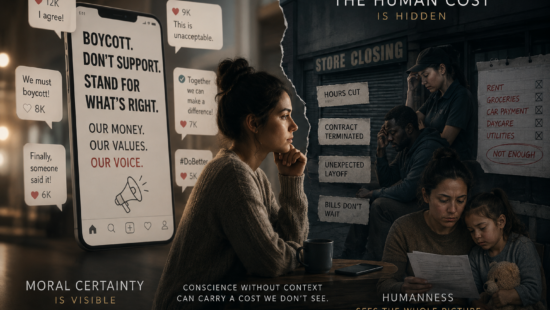 The Human Cost of Moral Certainty
  Humanness and the False Binary: Stewardship as the Missing Thread